Tarsheed Educational Publications
This volume is grounded in a vision that seeks to redefine the role of the teacher as a guide and facilitator-one who leads students toward deeper understanding, rather than simply transmitting information. By focusing on historical and narrative discourses, teachers are able to expand beyond traditional lessons, offering learners the opportunity to explore past experiences and to understand the meanings of events and stories from both social and cultural perspectives.
Crossing traditional school disciplines is not an end in itself, but rather a means of enriching the learning experience. It enables students to recognize connections across different areas of knowledge, such as history, literature, the arts, and social sciences.
This third volume is organized into three main sections comprising nine interconnected chapters. The first section introduces the foundations of integrative and communicative knowledge and explores the philosophical and historical dimensions of both historical and narrative discourse. The second section focuses on ways to activate historical discourse in education through the analysis of speeches, images, documents, and historical films, offering practical, classroom-ready activities and tasks. The third section centers on narrative discourse in its various forms - including myths, stories, and literary texts - and demonstrates how these can be used to enhance imagination, critical analysis, and connections to social and cultural realities.
This volume is guided by a vision that views integrative education not merely as a way to diversify content, but as a meaningful approach to enriching the learning experience. It calls on teachers to act as mentors and guides in a learning journey grounded in meaning, one that helps learners connect past and present, narrative and history, and knowledge with human experience.
We hope that teachers and education professionals will find in this volume a practical guide that enables them to engage with historical and narrative discourses in diverse ways, whether within formal curricula or through student clubs and field-based activities. We also aspire for this work to foster critical thinking and creativity among students, deepen their understanding of their historical and cultural heritage, and equip them with the intellectual tools needed to interpret their contemporary world and contribute meaningfully to its development.
It is important to note that the activities, tasks, and projects included in this volume have been carefully designed to strike a balance between comprehensiveness and flexibility. Rather than offering rigid pedagogical formulas or overly detailed prescriptions, the book recognizes teachers’ ability to adapt and apply these resources in ways that best suit their contexts and needs. At the same time, the content provides sufficient guidance and information to support the achievement of intended learning outcomes.
Through this publication, Tarsheed Educational Publications continues its commitment to providing scholarly and professional content that contributes to the development of Arab educational thought, while equipping teachers with both conceptual and practical tools to build more reflective and effective learning environments.
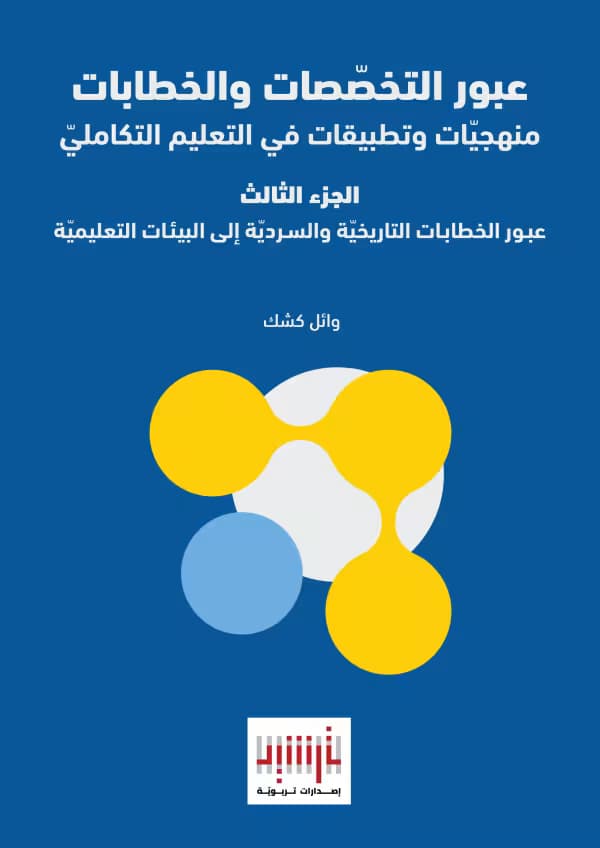
Authored by: Wael Kishk
Publication Date: September 2025
Publisher: Tarsheed Educational Publications
Paperback
Arabic Language
First Edition
Number of Pages: 398 pages