Tarsheed Educational Publications
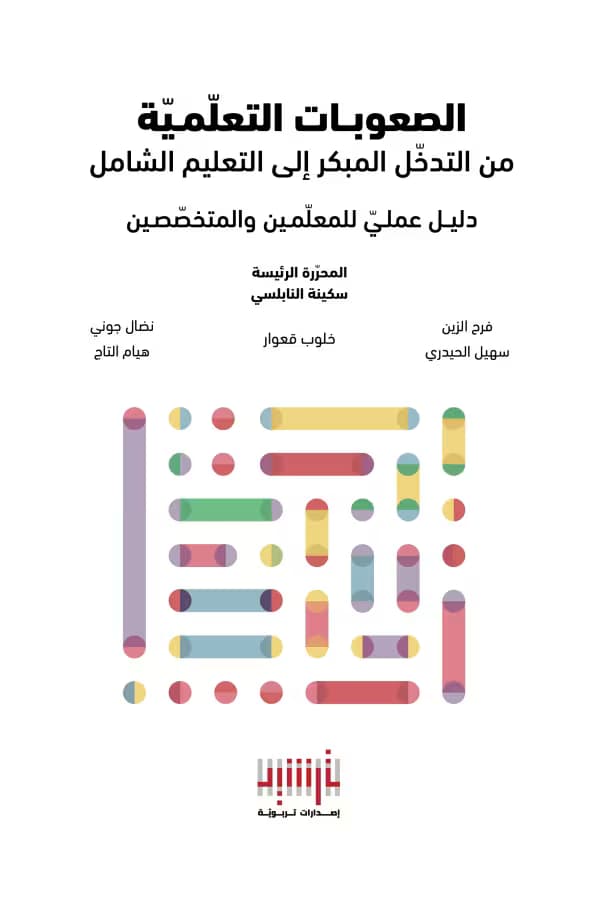
Tarsheed Educational Publications launched the book Learning Difficulties: From Early Intervention to Inclusive Education in response to a growing awareness of the significant gap within the Arabic educational library regarding the treatment of learning difficulties from a comprehensive, contextual, critical, and practical perspective. Existing resources are often either fragmented translations that fail to account for linguistic and cultural differences and contexts, highly theoretical works detached from classroom realities, or technical manuals that assume the existence of school structures largely unavailable in the Arab world. During this, teachers are frequently left alone, struggling between their care for their students and their inability to support them through clear, scientific, and applicable tools.
The book emerges as a response to a profound intellectual concern that intersects with teachers’ daily classroom experiences. Despite the increasing prevalence of learning difficulties in Arab schools, the issue has often remained confined either to abstract theorization disconnected from reality or to practices lacking scientific and contextual grounding.
The significance of this book lies in the fact that it does not approach learning difficulties as isolated individual conditions or narrow technical diagnoses. Rather, it views them as a lens revealing deeper imbalances in our conceptions of learning, difference, and success. A large number of children are labeled as weak or unmotivated, when in fact they are facing difficulties that have neither been properly understood nor educationally addressed. From this perspective, the book offers a critical and contextual framework that redefines the phenomenon and emphasizes that the child is not less capable, but instead requires a different educational approach. Consequently, schools are called upon to create more equitable and inclusive learning environments.
The book is structured around six integrated chapters. It begins by establishing foundational concepts and tracing the evolution of learning difficulties from medical to educational frameworks while taking the Arab context into consideration. It then addresses one of the most complex issues in the field: the linguistic differences between Arabic and English and their implications for diagnosis and learning. The book further highlights the importance of early intervention as a pivotal turning point in a child’s educational trajectory. It expands on diagnostic and assessment mechanisms while emphasizing contemporary shifts toward more inclusive models, such as multi-tiered systems of support. It also explores the interconnected relationship between learning difficulties and emotional and behavioral disorders, along with the complex challenges these pose for teachers and schools. The book concludes with a chapter on inclusive education, where inclusion is presented not merely as a slogan, but as an educational practice requiring clear tools and strategies.
In this way, the book offers a comprehensive framework that bridges theoretical understanding with practical application, providing teachers with adaptable tools and models suited to the realities and challenges of Arab schools.
The preparation of this book, undertaken by the team at Tarsheed Educational Publications alongside the chief editor Dr. Sukaina Al-Nabulsi and a group of Arab specialists -Dr. Suhail Al-Haidari, Dr. Khaloub Kawar, Ms. Nidal Jouni, Dr. Farah Al-Zein, and Prof. Hiyam Al-Taj, represented a journey in search of a delicate balance between hope and reality: between belief in education’s capacity for change and recognition of its limitations when separated from its broader social and intellectual foundations. It was also a journey that questioned dominant discourses surrounding “normality” and “exception,” and the silent exclusion of certain learners from educational pathways.
At its core, this book is not merely a technical guide, but rather an invitation to reconsider our understandings of learning, difference, and educational justice. It delivers a clear message: the child facing learning difficulties is not less capable, but simply in need of a different approach, and the teacher, when equipped with the necessary knowledge and tools, can make a genuine difference. As such, this work represents a step within a broader effort toward building an authentic Arabic educational knowledge base that empowers teachers, embraces diversity, and ensures every learner has a fair opportunity to learn and grow.